How it works
One accountable partner, from click to job.
The offer is bigger than ad management. Acquisition, conversion, lead handling and measurement run as one workflow, so you can see which spending turned into booked work.

01Reach
Ads and targeting
Campaigns for the services and neighborhoods you actually want, with budgets paced to your crew capacity, not to a spending target.
Starfish runs this stage.

02Engage
Landing experience
A fast, mobile-first page for each service: real project photos, a clear offer, and nothing that makes a homeowner work to reach you.
Starfish runs this stage.

03Inquire
Calls and forms
Calls, forms and booking requests routed to the right person in seconds, with a record of where each one came from.
Starfish runs this stage.

04Progress
Follow-up and estimates
Your team responds, visits and quotes. We make sure each estimate is connected back to the inquiry that started it.
You run this stage. We connect it to the report.

05Win
Booked work
Signed jobs and their value flow into the same report, so the conversation is about which spending produced profitable work.
You run this stage. We connect it to the report.
Clear accountability
Everyone knows who owns what.
Paid attention has little value if leads go unanswered, so response speed and estimate quality matter as much as the ads. Shared reporting connects both sides without promising results outside either one's control.
We run
- Campaign execution
- Landing pages and UX
- Tracking and measurement
- Testing and optimization
You run
- Response speed
- Quoting and estimates
- Sales
- Fulfillment
Measurement
Every inquiry remembers where it came from.
Each lead carries its source, from the ad that started it through qualification, the estimate and the job. That's where our engineering shows up, and it stays behind the scenes: no new app for your team to learn.
We report gaps honestly. If a job can't be traced to a source, the report says so instead of counting every form as a sale.
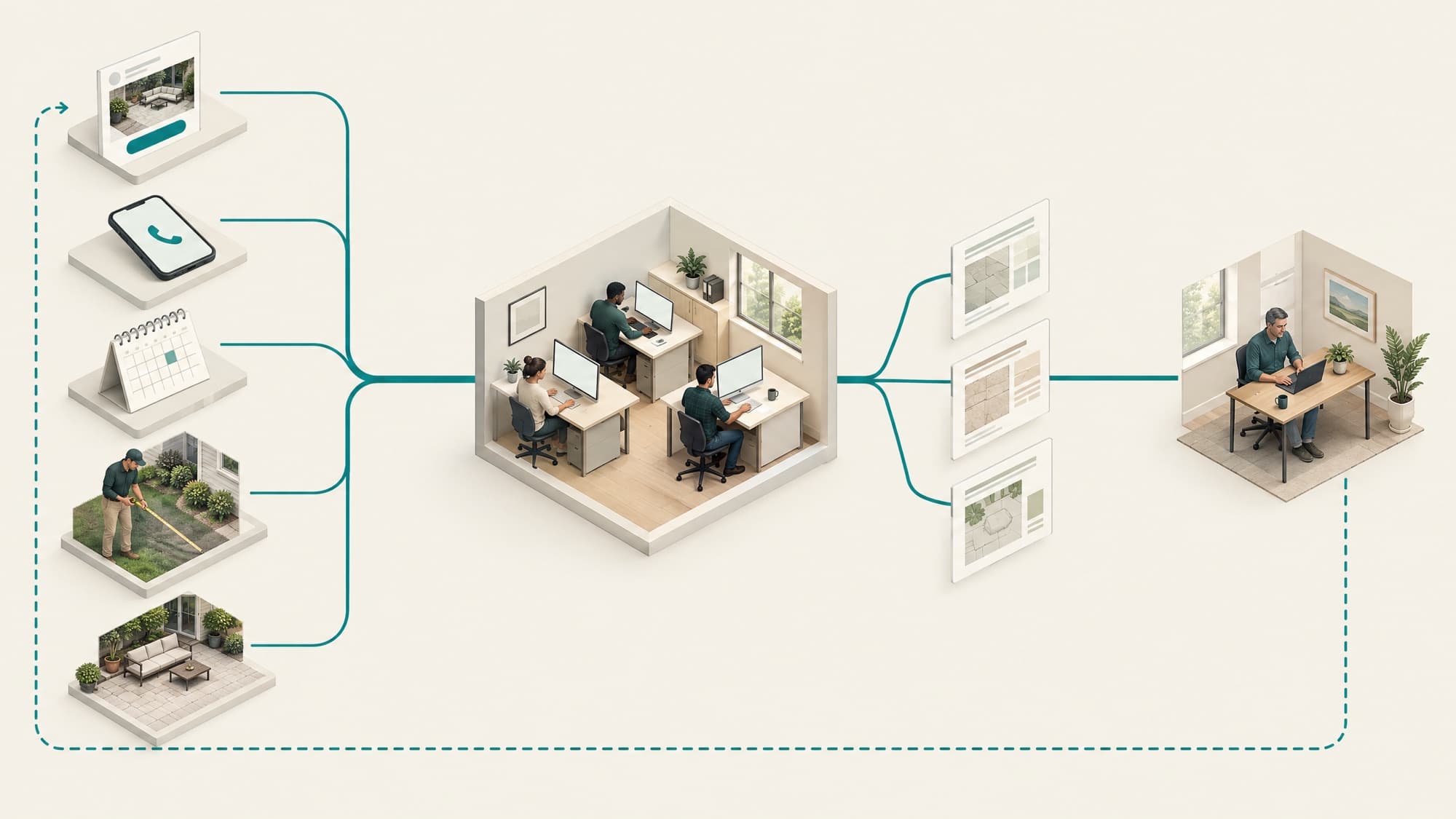
From the first ad to the finished job, one connected record.
The operating rhythm
Short updates. Clear decisions.
Experiments run with your approval, one change at a time, so you always know what moved the numbers.
- Every week
- Operating checks: tracking health, budget pacing, lead response and anything that broke.
- Every month
- A plain-language review in booked jobs and economics, ending in a short list of decisions.
- Every quarter
- A business review: what to keep, what to change, and whether to add a service, market or channel.
Next step
Start with a growth assessment.
A short review of your marketing, lead handling and job economics. You'll see where inquiries are being lost and how many extra jobs it takes to break even. It ends in a scoped pilot proposal.